New Construction Spray Foam Insulation
We insulate and air-seal new Durango-area builds to La Plata County's adopted Zone 5B requirements from the framing stage forward — including the log and timber-frame assemblies a standard batt was never designed to fit.
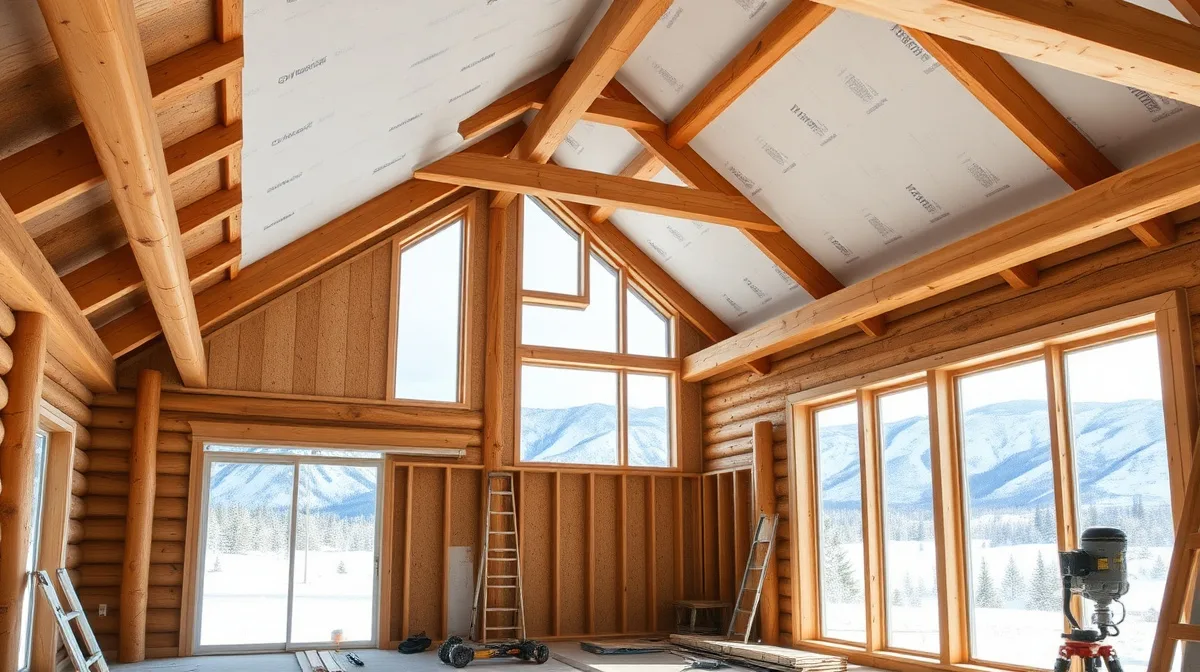
Durango sits at 6,512 feet in IECC Climate Zone 5B, and La Plata County's adopted 2021 IECC amendment reflects it: attic insulation at R-49, walls at R-20, targets set specifically for a genuine four-season mountain climate rather than a milder baseline. That code is the floor we build to on every new home, cabin, and addition we insulate in and around Durango — not a target we hit only when an inspector is watching. The area's building market also includes a real, active segment of log and timber-frame construction — builders working in post-and-beam roof assemblies, cathedral ceilings, and round-log or hewn-timber wall systems that a standard fiberglass batt was never designed to fit. Spray foam's ability to expand and conform to irregular cavities is a genuine, practical advantage in that kind of build, not a marketing point.
New construction is the best point in a project's life to get insulation and air-sealing right, because spray foam goes onto open framing before drywall closes anything in. That means full roof-deck or attic-plane coverage, a continuous seal at every top plate, band joist, and penetration, and a building envelope that performs the way it's supposed to the first winter it's occupied — instead of getting chased down after the fact with caulk and foam cans. For a home that will spend real winters at this elevation, that shows up immediately in comfort, in reduced ice-dam risk at the eaves, and in what it costs to hold a comfortable indoor temperature when it's well below freezing outside.
Why homeowners choose it
- Hits La Plata County's R-49 attic and R-20 wall targets in a single application instead of layered retrofits.
- Builds a continuously sealed envelope during framing, closing top-plate, band-joist, and penetration gaps before drywall makes them hard to reach.
- Fills irregular log, timber-frame, and post-and-beam cavities that standard fiberglass batts can't conform to.
- Insulates and air-seals rim joists and band joists — details that are difficult or impossible to correct once walls are closed in.
- Gives builders and owners a documented, code-compliant assembly that simplifies energy inspections down the line.
- Reduces long-term heating costs for the life of the building, starting with the very first winter it's occupied.
Building to La Plata County's Zone 5B Numbers, Not a Milder Baseline
A builder who insulates to a generic, lower-elevation spec is insulating for the wrong climate. La Plata County's adopted 2021 IECC amendment sets Durango's targets at R-49 for attics and R-20 for walls — numbers that match the prescriptive tables for a genuine Zone 5B climate, not a warmer one. Those numbers exist because Durango genuinely earns them: sustained sub-freezing stretches, real snow load, and a building season that has to account for both.
We build every new-construction project to those local numbers, coordinating with the general contractor and any energy rater on record so the insulation and air-sealing work lines up with what's specified on the plans — and so nothing gets flagged and reworked after drywall is hung.
- Attic / roof deck: R-49 minimum, with an R-49 to R-60 upgrade path available for higher-performance builds
- Walls: R-20 per La Plata County's adopted 2021 IECC amendment
- Continuous air-sealing at top plates, band joists, and penetrations during framing, before drywall closes anything in
Insulating for Log and Timber-Frame Construction
Durango and the surrounding San Juan Mountains are genuine log and timber-frame building country, with real, active builders in the market — DC Builders, PrecisionCraft, Durango-headquartered Log Homes of the South, Integrity Timber Frame, and Frontier Log Homes among them. That style of construction produces cathedral ceilings, exposed post-and-beam roof structures, and round-log or hewn-timber wall assemblies with irregular cavities that a fiberglass batt handles poorly, if at all.
New construction lets us choose the right foam for each assembly rather than retrofitting around what's already there. Closed-cell foam typically goes where R-value per inch matters most in limited or irregular framing depth — rim joists, foundation walls, and post-and-beam roof cavities. Open-cell foam does the heavy lifting in deeper standard wall cavities and conditioned attics, delivering full-cavity air-sealing and sound-dampening at a lower installed cost where the extra R-value per inch of closed-cell isn't required.
- Fills cathedral ceilings and post-and-beam roof cavities that batts can't conform to
- Closed-cell foam for rim joists, foundations, and irregular framing where density matters most
- Open-cell foam for deeper standard wall and attic cavities where cost-effective air-sealing is the priority
- Bonds to non-standard framing without requiring custom-cut insulation pieces for every angle
Coordinating Spray Foam Into Your Build Schedule
Spray foam has to land at a specific point in the framing sequence — after rough electrical, plumbing, and HVAC are in and inspected, but before insulation is covered by drywall. We work directly with the general contractor's schedule to hit that window without becoming the bottleneck, and we coordinate with whoever is running energy code compliance so any required testing has a clean, sealed envelope to work against.
Because closed-cell and open-cell foam both need a minimum substrate and ambient temperature to cure properly, winter-schedule builds in Durango sometimes require sequencing around cold snaps or temporary heat on site — something we plan for from the initial walkthrough rather than discovering mid-project. For builders running multiple lots, we can also standardize the spec across a subdivision so every unit hits the same R-value target without lot-by-lot guesswork.
Ideal for
- Custom home builders framing new residential construction in and around Durango
- Log and timber-frame builders and owner-builders needing cavity-filling insulation for irregular assemblies
- Production and spec-home builders who need consistent, code-compliant envelopes across multiple lots
- Architects and owner-builders designing high-performance homes at elevation
- Cabin and second-home construction in the Purgatory corridor or around Vallecito Lake meant to sit vacant part of the year
What affects the cost
New Construction questions, answered
We build to La Plata County's adopted 2021 IECC Zone 5B requirements specifically: R-49 attics and R-20 walls at minimum. Those are the numbers Durango's inspectors are actually checking for, and they're set for a genuine cold-climate mountain zone.
Yes — it's one of the better insulation choices for that kind of construction. Spray foam expands to fill the irregular cavities around round logs, hewn timbers, and post-and-beam roof framing that batts can't conform to, and it bonds structurally to non-standard sheathing and framing.
After rough electrical, plumbing, and HVAC are installed and inspected, but before drywall. We coordinate directly with your general contractor's schedule and, where applicable, with whoever is running energy code compliance so testing lines up with a clean, sealed envelope.
Usually both, applied where each performs best. Closed-cell goes in rim joists, foundation walls, and irregular or shallow-framing assemblies where R-value per inch and rigidity matter most; open-cell handles full-cavity air-sealing in deeper standard wall and attic assemblies at a lower installed cost.
Yes. For builders running multiple lots, we standardize the assembly spec across the project so every unit hits the same R-value targets, which simplifies inspections and keeps per-unit costs more predictable than one-off custom quotes.
New Construction done right, by a local Durango crew
New Construction isn't a commodity — the result depends entirely on how carefully it's planned and installed for your specific home and Durango's real high-country climate. We assess what your house actually needs, prep and air-seal properly, and install to your elevation-appropriate R-value target, so the work delivers the comfort and savings it's supposed to.
We serve Durango, Bayfield, Vallecito Lake, Hermosa, Mancos, Hesperus, and Ignacio. Every job starts with a free, no-pressure quote.
Just as important, we treat your home like the system it is. Insulation, air sealing, and ventilation all interact, and getting one right while ignoring the others leaves comfort and savings on the table. When we scope your new construction, we look at how it fits the whole picture — so the finished result performs the way it should, holds up through a genuine Durango winter, and actually lowers the bills you feel every month.
Free assessment
We evaluate your home and give you a clear, itemized quote.
Expert install
We prep, air seal, and install your new construction to spec — clean and on schedule.
Savings you can feel
A warmer home, lower heating bills, and honest advice about what your home needs.
Related services
Ready for a free new construction quote?
Tell us about your home and we'll put together a clear, no-pressure spray foam insulation quote — built for Durango's real mountain winters.