Spray Foam Insulation Cost Guide for Durango, CO Homes (2026)

If you've priced insulation contractors in Durango and gotten three wildly different numbers, you're not imagining things. Spray foam pricing genuinely varies more than fiberglass or blown cellulose because it depends on which area of the home you're treating, whether the job calls for open-cell or closed-cell foam, how much existing insulation and framing you have to work around, and — specific to this market — how much material it takes to hit the R-values a home at 6,512 feet in the Animas River valley actually needs to perform through a real Southwest Colorado winter.
This guide breaks down real-world cost ranges by area of the home, explains why open-cell and closed-cell foam price out differently, and walks through the math homeowners actually care about: how spray foam insulation costs stack up against what you're currently paying to heat a drafty, under-insulated house through a Durango winter. Every number here is a typical range, not a quote — your home's framing, access, existing insulation condition, and target R-value all move the final price, which is exactly why we push toward a free on-site assessment before anyone commits to a number.
Why Durango Sits in a Genuine Cold-Climate Building Code
Durango sits at 6,512 feet at the foot of the San Juan Mountains, and La Plata County has adopted the 2021 IECC with local amendments that reflect it: minimum R-49 ceiling/attic insulation and R-20 wall insulation, numbers that put Durango squarely in IECC Climate Zone 5B. That's a real Rocky Mountain climate — January averages a high near 38°F and a low near 12°F, and the town sees somewhere in the neighborhood of 67 to 70 inches of snow in a typical year (the high country above town, like Purgatory Resort roughly 30 to 40 minutes north on US-550, sees dramatically more — that figure doesn't apply down in the valley, but it tells you what kind of weather system regularly rolls through). Hitting R-49 and R-20 targets simply takes more spray foam material per square foot than a milder-climate job, which is one of the biggest reasons a generic national cost estimate undershoots what a Durango home actually needs.
Spray Foam Insulation Cost by Area of the Home
Spray foam is typically priced per square foot installed, but the effective cost per square foot changes a lot depending on which assembly you're insulating, the thickness of foam required to hit target R-value, and how easy or difficult that area is to access. Below are realistic ranges for the areas we install most often in Durango and La Plata County homes.
Attic Spray Foam Insulation Cost
Attics are the single biggest lever for stopping heat loss and preventing ice dams, and they're usually the largest line item on a whole-home spray foam project. For a roof-deck or conditioned-attic application targeting La Plata County's R-49 minimum (with R-49 to R-60 as an aspirational upgrade range for homeowners chasing maximum performance), most Durango attic projects fall within the broader industry-typical range of $0.75 to $4.50 per square foot installed, with the wide spread driven almost entirely by square footage, roofline complexity (dormers, valleys, hip roofs versus a simple gable attic), and whether closed-cell foam is used at the roof deck for its higher R-value per inch. Complex rooflines — common on log and timber-frame homes with cathedral ceilings and post-and-beam construction — trend toward the higher end of that range because spray foam has to fill irregular cavities that batt insulation simply can't conform to.
Wall Spray Foam Insulation Cost
Wall insulation pricing depends heavily on whether the walls are open (new construction or a gut remodel) or closed (retrofit work in an existing finished wall). Open-wall applications, where foam is sprayed directly into stud bays before drywall goes up, are generally more cost-efficient per square foot than closed-wall retrofit work, which requires small access holes and more labor per square foot of coverage. To meet La Plata County's R-20 wall minimum, most whole-house wall projects run within the same general $0.75-$4.50 per square foot installed range as other spray foam work, with closed-cell chosen more often in standard 2x4 or 2x6 framing where there isn't much depth to spare.
Crawl Space Spray Foam Insulation Cost
Crawl space work is priced by square footage of foundation wall and/or subfloor being treated, and it's one of the highest-value freeze-protection projects we do in this climate. Targeting a typical industry-standard R-30-plus crawl space range, most crawl space spray foam projects fall in a similar per-square-foot band to attic work, with total project cost driven by crawl space size, height and access, and whether there's existing moisture or old insulation that needs to be dealt with first. Closed-cell foam is the standard choice here because it also acts as a moisture barrier, not just an insulation layer — a real consideration given how much snowmelt a La Plata County property deals with each spring.
Rim Joist and Band Joist Insulation Cost
Rim joists — the band of framing that sits on top of the foundation wall, typically the source of cold floors and drafts homeowners complain about most in a Durango winter — are a smaller-scope project on their own, and pricing usually reflects that. Because rim joists are commonly the most heat-leaky, air-leaky part of a home's envelope and are relatively quick to access from a crawl space or basement, rim joist spray foam is often bundled into a larger crawl space project rather than priced as a total standalone job. Closed-cell foam is essentially the default here given the assembly's thin depth and the need for both air-sealing and real R-value in a small amount of material.
Open-Cell vs. Closed-Cell: Why the Price Difference Exists
Across the whole spray foam category, installed pricing generally runs from about $0.75 to $4.50 per square foot, with open-cell foam sitting at the lower end of that range and closed-cell foam at the higher end. That spread isn't arbitrary — it comes down to density and R-value per inch. Open-cell foam expands to a lighter, softer density and delivers roughly R-3.5 to R-3.7 per inch, which means it costs less per board-foot but needs more material thickness to hit a given R-value target. Closed-cell foam is a denser, more rigid product that delivers roughly R-6 to R-7 per inch — nearly double the R-value per inch of open-cell — along with a built-in moisture barrier and added structural rigidity. For comparison, fiberglass batts run roughly R-2.9 to R-3.8 per inch in real-world installs, which is why simply adding more fiberglass rarely closes the performance gap the way switching to closed-cell foam does.
In a cold, high-elevation Zone 5B climate like Durango's, that R-value-per-inch difference matters more than it would in a mild climate, because hitting the county's R-49 attic and R-20 wall minimums inside a limited framing depth often pushes the choice toward closed-cell, especially in rim joists and standard wall cavities where there simply isn't room for enough open-cell foam to get there. Open-cell still has a strong place in this market — it's a good fit for interior wall sound-dampening and for conditioned attic applications where framing depth isn't a constraint. The right call between the two comes down to which assembly you're insulating, how much depth is available, and whether moisture performance is part of the job — which is exactly what an on-site assessment sorts out before you commit to a number.
Cost Drivers Specific to Durango's Elevation and Climate
A few things push Durango spray foam pricing in a direction that generic national cost content doesn't account for.
- Higher R-value targets mean more material. La Plata County's 2021 IECC amendment calls for R-49 attic and R-20 wall minimums — hitting those numbers simply requires more spray foam thickness, and therefore more material cost, per square foot than a milder-climate job.
- Irregular framing in log and timber-frame construction. Durango has a real, active log and timber-frame building segment, and post-and-beam assemblies, cathedral ceilings, and hand-hewn log cavities are notoriously hard to insulate with batts. Spray foam expands to fill those irregular gaps completely, which is a genuine performance advantage but can mean more material and labor than a standard stick-framed attic.
- Elevation and four-season exposure. At 6,512 feet in the Animas River valley, homes deal with real snow load, sustained freezing temperatures, and repeated freeze-thaw cycling — conditions that make air-sealing, not just R-value on paper, a meaningful part of the job.
- Access and site conditions. Winter installation windows, snow-covered access, and crawl spaces built for freeze protection rather than mild-climate venting can add time to a job compared to a warm-climate equivalent.
- Existing insulation and remediation. Many La Plata County homes were built between the mid-1970s and 1990s, and older insulation that's settled, compressed, or otherwise failed often needs to be dealt with before spray foam goes in, which adds cost versus a bare-cavity job.
- Home age and prior work. Homes that have already had partial upgrades — a re-roof, a remodel, or DIY insulation patches — sometimes need more assessment time to figure out what's actually behind the walls before a firm number can be given.
Cost vs. Savings: What the Math Actually Looks Like
The number homeowners actually care about isn't the installed cost in isolation — it's how that cost compares to what they're already paying to heat a home that's losing warm air through an under-insulated attic, drafty walls, and an uninsulated rim joist all winter. Durango homes see heating costs climb hard from November through March, and a poorly insulated, poorly air-sealed house is effectively paying to heat the attic space and the outdoors along with the living space.
Here's the mechanism: fiberglass batts and blown cellulose only slow heat transfer — they don't stop air movement, and in a home with real air leakage, warm conditioned air is constantly escaping through gaps around top plates, can lights, plumbing penetrations, and the attic hatch, while cold air infiltrates from outside. Spray foam insulates and air-seals in the same application, which is the real reason it outperforms fiberglass or cellulose of a similar R-value on an actual heating bill — it's not just slowing conduction, it's stopping the air exchange that conduction-only insulation can't touch.
How fast that translates into a payback period varies significantly and honestly — sourcing on this disagrees widely, and we'd rather be straight with you than quote an optimistic number. Payback depends heavily on your home's current insulation condition, air-leakage rate, square footage, and heating system efficiency. We walk through realistic expectations for your specific home during your free assessment rather than publishing a single generic payback timeline that may not hold up for your house.
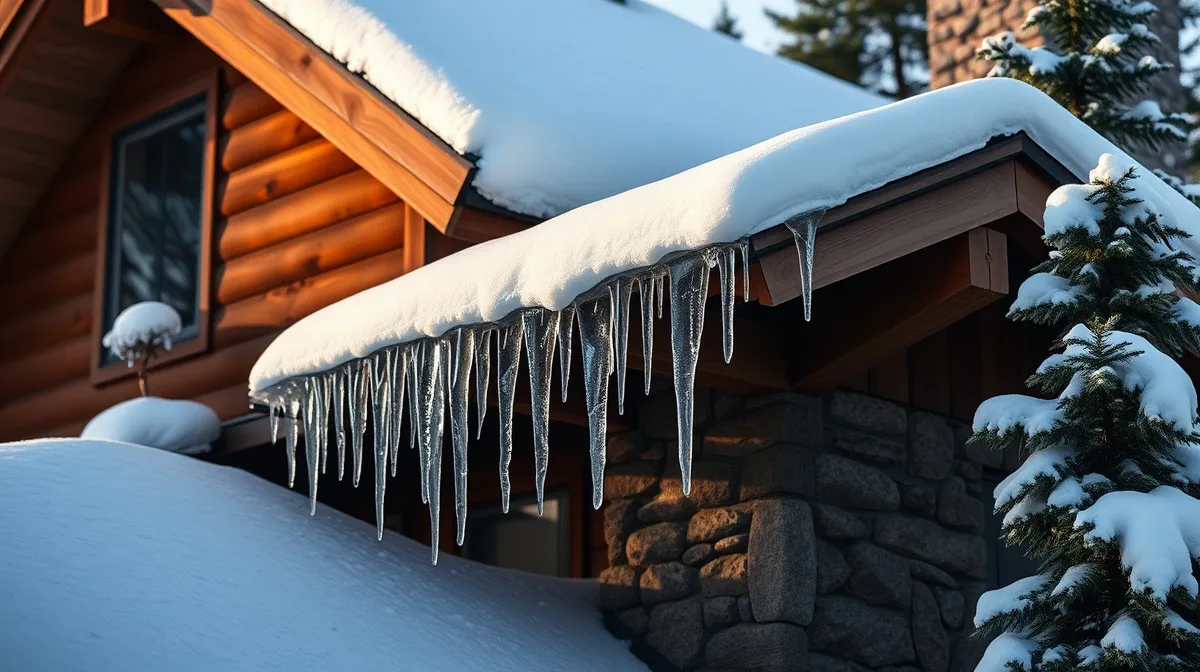
The other side of that math is ice dams. Beyond any direct heating-bill savings, an under-insulated, poorly air-sealed attic loses heat straight up into the roof deck, which melts the underside of the snowpack; that meltwater runs down to the cold eave overhang beyond the heated part of the house and refreezes, building up ice dams that back water up under shingles and into the roof structure. Spray foam at the roof deck stops that cycle at the source rather than treating the symptom with heat cables or roof raking every storm — a cost avoidance that doesn't show up on a monthly bill but shows up in avoided roof and interior water damage repairs.
How Durango's Log and Timber-Frame Homes Change the Cost Picture
Durango has a genuine, active log and timber-frame building segment, with real regional builders — DC Builders, PrecisionCraft, Durango-based Log Homes of the South, Integrity Timber Frame, and Frontier Log Homes among them. That's not a niche curiosity in this market; it's a meaningful share of both new construction and the existing housing stock, especially in outlying areas around Bayfield, Vallecito Lake, and Hermosa. Post-and-beam framing, cathedral ceilings, and irregular log cavities are notoriously difficult to insulate with fiberglass batts, which are manufactured as flat, uniform rectangles and were never designed to conform to the curved, tapered, and irregular gaps common in this style of construction.
Spray foam's expansion behavior is a genuine, non-generic advantage here — it fills irregular cavities completely as it cures, rather than leaving the gaps and voids that batts leave behind in a non-standard framing assembly. That performance advantage does come with a cost note worth being upfront about: cathedral ceilings and post-and-beam roof assemblies often take more time and more careful application than a flat, open-truss attic, which can push a log or timber-frame project toward the higher end of the per-square-foot ranges above. It's a fair tradeoff for a home style that fiberglass genuinely underperforms in, and it's a big part of why we walk the actual roof and wall assemblies during an on-site assessment rather than quoting off square footage alone.
Financing and How to Think About ROI
Spray foam insulation is a durable-goods home improvement, not a consumable, and it's reasonable to think about the cost the same way you'd think about a furnace replacement or a roof — as an investment, not just an expense. Because spray foam both insulates and air-seals permanently (it doesn't settle or lose R-value the way blown cellulose or fiberglass can over years), whatever heating-cost benefit it produces continues every year the home is occupied, not just in year one. Financing options are commonly available for larger whole-home projects; ask about current options during your assessment.
Getting an Accurate Number for Your Home
Every range in this guide is a real, typical range — but your home's actual price depends on things a blog post can't see: your attic's square footage and roofline complexity, whether your walls are open or closed, your crawl space's height and access, the condition of any existing insulation, and which combination of open-cell and closed-cell foam makes sense for your specific assemblies. Two homes of the same square footage in the same La Plata County neighborhood can land at meaningfully different total costs once those factors are accounted for.
The only way to turn these ranges into a firm number is a free, no-obligation on-site assessment, where we measure the actual areas being treated, look at existing insulation and any air-leakage issues, and walk through which combination of open-cell and closed-cell foam gets your home to La Plata County's R-49/R-20 targets without over- or under-spending on material you don't need.
Frequently asked questions
Most spray foam projects fall within the typical industry range of about $0.75 to $4.50 per square foot installed, with a whole-home project (attic, walls, crawl space, and rim joists) commonly running $4,700 to $11,250 as an example estimate, not a quote. Actual cost depends on square footage, target R-value, and access — a free on-site assessment is the only way to get a firm number for your home.
Yes, closed-cell foam generally costs more per square foot than open-cell because it's denser and delivers roughly R-6 to R-7 per inch versus open-cell's R-3.5 to R-3.7 per inch. In Durango's cold, high-elevation climate, that higher R-value per inch is often worth it in rim joists, crawl spaces, and limited-depth wall cavities where hitting La Plata County's R-49/R-20 targets requires more R-value packed into less space.
Payback varies significantly based on your home's current insulation condition, air-leakage rate, and heating system — there's no single honest number that applies to every Durango home, and we're skeptical of anyone who quotes one without seeing your house. We'll walk through realistic expectations for your specific property during your free assessment.
No — these are typical ranges based on real industry cost data, not a quote for your specific property. Your final cost depends on square footage, roofline or crawl space complexity, existing insulation condition, and which foam type fits each assembly. A free on-site assessment is the only way to get an accurate number.
Ready for a free quote?
Tell us about your home and we'll build a clear, no-pressure quote.